RESISTANCE AND ESCAPE
Following Germany's attack on Denmark in 1940, the Danish government
remained intact and life continued much as it had before Germany's
invasion. However, as months passed, the Danes quickly tired of the Nazi's
presence. Dissatisfaction rose throughout 1942 and an organized resistance
movement formed in the spring of 1943, which culminated in the mass rescue
of Danish Jews in October 1943.
Prior to the rescue, resistance took many different forms. Because both
the country of Denmark and its army were so small, the Danish government
did not want aggressive actionto take place between Danes and Nazis; they
felt that Germany would retaliate swiftly and viciously, leading to the
loss of Danish life and the endangerment of Danish Jews. Therefore, Danes
fought the Nazis in non-violent, sometimes secretive ways that did not
bring Danish into direct contact with Nazi soldiers. These methods
included using newspapers, both legal and illegal, and radio programs to
bring news from England and the Allies; importing or printing books banned
by the Nazis; preparing for the prospect of armed combat and engaging in
weapon smuggling for the possibility of active battle; relaying
information about Nazi activities and positions to Allied contacts via
radio and bicycle; detonating explosives at major Nazi resource sites in
Denmark; and numerous other ways.
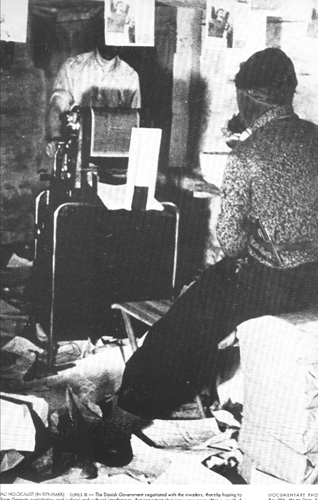
Newspapers
played a large role in the resistance movement. Despite the Nazi presence
in Denmark, Danish journalists retained a great amount of freedom in their
jobs after the invasion. Denmark's newspaper reporters were quite savvy,
and they felt comfortable covering major stories. Nor were Danish
journalists afraid to test the limits of their rights as journalists.
Germany assigned censors to control the flow of information to the Danish
public. Danish newspapers ran suggestive headlines and stories and
juxtaposed articles in a way that subtly made fun of, or criticized
Germany. Layout departments manipulated the organization of newspapers in
every way possible, sometimes placing stories of Nazi victories at the
bottom of a page or end of a section. Illegal newspapers were also a form
of Danish resistance during World War II. In addition to controlling the
writing of Danish journalists, Nazi censors controlled the information
that entered Denmark. Censors did not allow Danes to read about Allied
victories or German defeats, and they continuously slanted or omitted
events. Underground newspaper publishers wanted Denmark to know both sides
of these stories. These publications covered other acts of Danish
resistance, and the papers lent support to the underground movement.
Publishers of these papers risked imprisonment, among other punishments.
Despite these risks, the illegal newspaper movement continued to gain
writers and readers in Denmark during the War.
|
The "V" campaign was another form of resistance closely tied
to newspapers. The British-based BBC created this campaign, and it quickly
spread across Western Europe and into Denmark. The letter "V"
stood for "victory [over the Nazis]," and its look-to-the-future
message boosted morale across Europe and in Denmark. Danes painted Vs on
posters and on building walls. Vs were also prominently included in
letters and cards, and Danish newspapers emphasized V-words in articles,
headlines, and advertisements. Radio announcers purposefully used words
beginning with V in their programs as a way to subtlety raise the hopes
and spirits of listeners. Radio personalities did not have access to the
various avenues of resistance of Danish newspapermen, but they managed to
resist the Nazis in unique ways. Radio employees used their voices to
communicate their disapproval of Germany: Nazi war reports were read,
although in low, unenthusiastic voices.
|
One of the most popular and widespread forms of Danish resistance was
the "cold shoulder." Everyone, including King Christian,
tolerated Germany's presence; Denmark's citizens did not, however, extend
their efforts beyond this minimal recognition. The Nazis received only "aloof
cooperation," from the Danes, and the collective Danish stubbornness
kept Germany at a distance. The situation in Denmark worsened throughout
the spring of 1943.
Next, click
here to read about the concentration
camp Theresienstadt