Theresienstadt
|
Of
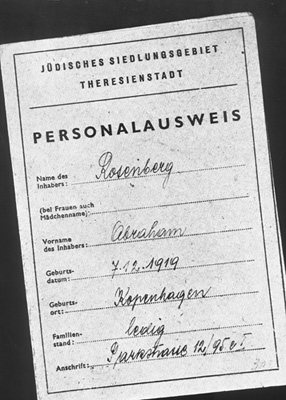
the eight thousand Jews living in Denmark in October 1943, approximately
7500 managed to escape to Sweden with help of fellow Danes. The remaining
450 were unable or unwilling to escape and were sent to Theresienstadt, a
Nazi concentration camp.
Located in Czechoslovakia, Theresienstadt was not a death camp; the
Nazis did not exterminate Jews at Theresienstadt. The camp mainly served
as a stopping point for Jews enroute to Nazi death camps further east. As
in other concentration camps, conditions in Theresienstadt were terrible.
Overcrowding and malnutrition killed thousands of prisoners and disease
killed thousands more. Only one in eight new arrivals survived.
|
Meanwhile, Denmark worked to improve the survival odds for the Danish
Jews imprisoned in Theresienstadt, starting shortly after the first group
arrived. Within days of the German raid on Jewish homes, Danish officials
began to ask Germany about the fate of those shipped to the camp.
In November 1943, only days after the last group of Danish Jews arrived
at Theresienstadt, the Danish Red Cross received permission to send
clothing parcels to Danish Jews. Volunteers in Denmark entered the homes
of these prisoners, collected personal clothing, and shipped the parcels
to Theresienstadt on behalf of the Danish Red Cross.
Although the Nazis agreed to allow clothing parcels into Theresienstadt,
they would not allow Danes to send medicine to the Danish Jews. A solution
was soon found: vitamins. Considered neither food nor medicine, vitamins
proved to be a valuable supplement for the prisoners. Within a few months,
each Danish Jew received more than a year's supply; the surplus was shared
with non-Danes.
The next item on the list was food: how could the Danish Red Cross send
food to the prisoners when the Germans would not allow it? Germany allowed
Jews to receive personal mail in Theresienstadt, so the Red Cross sent
food parcels directly to individuals rather than in bulk--right under the
noses of German postal workers.
During the winter of 1943, the Danish Red Cross requested an opportunity
to inspect the camp. Germany agreed, but only on the condition that the
inspection team wait until the following summer. Jewish laborers
immediately began to transform the edifice of Theresienstadt from a dirty,
dingy camp to a bright, sunny, cheerful Jewish "town." Jewish
prisoners planted flowers, painted, and scraped. Overcrowding was a
problem, and the Nazis did not want the Red Cross team to report these
conditions to the world. Instead, they shipped thousands of new arrivals
directly to death camps in eastern Europe instead of sending them to
Theresienstadt first.
By the time the committee arrived in June 1943, the Nazis had provided
the Danish prisoners with scripts; the Nazis threatened them with
deportation should the prisoners resist the plan. A group of Danish Jews
welcomed the committee; the group toured the "town," passing
playgrounds, gardens, and newly-painted dwellings as they made their way
toward Danish living quarters. For some reason, the Red Cross
representatives did not notice, or chose to ignore "surplus"
Danish Jews hiding upstairs. They returned to Denmark with pleasing
reports of Theresienstadt.
At first, the Danish Jews imprisoned in Theresienstadt were frustrated
and saddened by the failure of the committee to discover the truth. They
soon found, however, that the visit had been somewhat beneficial. The
Germans were elated with the committee's positive reports. In return for
the Danish prisoners' cooperation, Germany promised them that they would
remain at the camp rather than being sent to a death camp. The Nazis also
improved living conditions and increased the food rations to the Danish
Jews.
Upon the liberation of Theresienstadt in 1945, only 17,320 prisoners of
an estimated 140,000 remained in camp; all others has been shipped to
death camps or died from disease within the walls of the camp. Amazinly,
approximately 400 of the 450 Danish Jews originally sent to the camp in
October 1943 survived.
Source: The Bitter Years: The Invasion and Occupation of Denmark and
Norway April 1940-May 1945 by Richard Petrow.
Next, click
here to read about the escape of the
Danish Jews