September 1943-May 1945
Following the rescue of Danish Jews in the fall of 1943, Germany
tightened its control over Denmark. The Nazis removed the State of
Emergency originally enacted August 29, but the situation was very poor.
Denmark cooperated with Germany as little as possible.
|
In
response to this attitude, Germany announced in December 1943 that any
Danish businesses refusing to hand over goods to the Nazis would be
destroyed. Meanwhile, the Danish resistance improved in accuracy as it
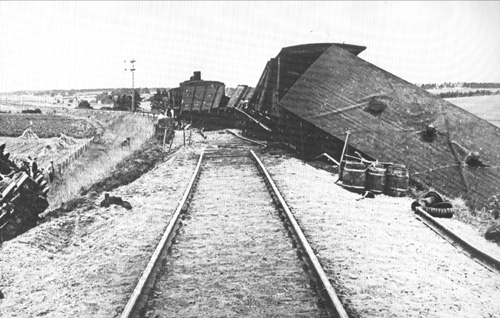
worked to obstruct German progress. Underground workers blew up railroad
systems used by Germany to transport troops into Northern Europe and
Scandinavia. In response, Germany captured many resistance members and
deported them to concentration camps. The Nazis considered members of the
Danish police to be responsible for the steady growth in resistance; in
1944, Germany sent almost the entire police force to camps.
|
The Danish government that had been in place until September 1943 did
not return to power. The parliament no longer existed, and King Christian,
in effect, no longer was the king. He had no power and was under house
arrest. The main source of guidance for Danes arrived in the form of the
Danish Freedom Council. This council now openly served as the main body of
the Danish Resistance, and the nation looked to its members for
leadership. During the spring of 1945, Germany's control slipped on every
military front. On May 5, the Nazis finally surrendered to the Allies.
Danes hung welcome signs and thank-you posters in preparation for the
arrival of British troops; white candles glowed in the windows of most
Danish homes, symbolizing solidarity and hopefulness. After more than five
years of German occupation, Danes would once again rule Denmark.
World War II took its toll on populations across Europe. Denmark lost a
fair share of citizens, but its numbers were not nearly as high as in
neighboring countries. According to Richard Petrow, author of The
Bitter Years: The Invasion and Occupation of Denmark and Norway April
1940-May 1945, overall Danish figures show that from a total of 5, 975
Danes imprisoned in [German camps], there were 562 deaths. This number
includes "fifty-eight deaths from among 474 Danish Jews." The
numbers would have undoubtedly been higher had Denmark not worked to
protect its citizens from harm.
Source: The Bitter Years: The Invasion and Occupation of Denmark and
Norway April 1940-May 1945 by Richard Petrow and "Denmark during
the final years," Royal Danish Embassy, Washington, D.C.
http://www.denmarkemb.org
Click
here to return to the main menu of The
Yellow Star Guide.